Most conversations about artificial intelligence focus on jobs:
Which industries will disappear.
Which careers will survive.
Which skills will remain valuable.
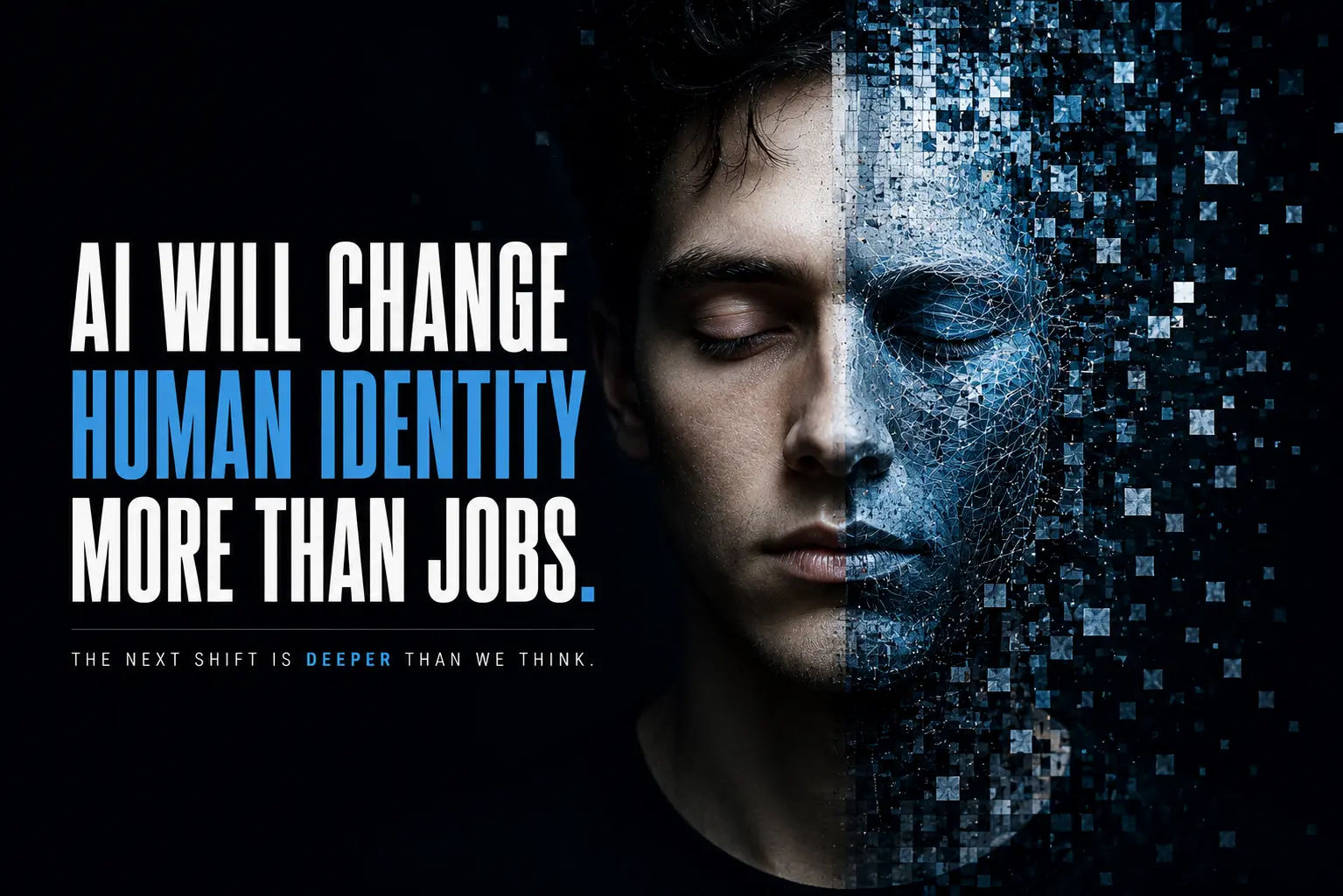
Those questions matter. But they may not be the deepest change AI creates. The larger transformation could be psychological.
AI may change how human beings understand:
- intelligence
- creativity
- value
- purpose
- identity itself
Work Has Always Shaped Identity
For many people, identity is closely connected to usefulness.
People often define themselves through:
- careers
- skills
- expertise
- productivity
- social contribution
Work provides more than income. It provides structure, recognition, meaning, and a sense of place within society. That is why technological disruption affects more than economics. It affects self-perception.
Intelligence Is No Longer Exclusively Human
For most of history, advanced reasoning and creativity were considered uniquely human abilities.
Now AI systems can:
- write essays
- generate art
- compose music
- solve problems
- simulate conversation
- produce software
- imitate creativity
The result is psychologically disorienting for many people. Not because machines became conscious. But because humans are beginning to question what makes their own abilities unique.
The Meaning Of Creativity May Change
Creativity has traditionally been associated with individuality and human expression.
AI complicates that idea.
When machines can generate:
- paintings
- stories
- videos
- designs
- music
people begin asking difficult questions:
What makes creativity meaningful? What makes something authentic? What remains distinctly human?
These are not only technological questions.
They are existential ones.
AI May Intensify Comparison
Social media already increased comparison between humans.
AI could expand that pressure further.
People may increasingly compare themselves against:
- AI-generated productivity
- AI-generated intelligence
- AI-generated creativity
- AI-enhanced performance
This creates a world where many individuals feel perpetually inadequate compared to systems optimized for efficiency and output.
The psychological consequences could become significant.
Human Value May Need Redefinition
Modern culture often measures value through:
- productivity
- speed
- output
- economic usefulness
AI may challenge those measurements directly.
If machines become capable of performing many cognitive tasks more efficiently than humans, society may eventually need to rethink what gives life meaning beyond productivity alone.
That could become one of the defining psychological questions of the future.
Attention And Reality Could Become Increasingly Artificial
AI will likely influence:
- information
- communication
- entertainment
- relationships
- social interaction
People may spend increasing amounts of time interacting with:
- AI-generated content
- synthetic personalities
- algorithmically personalized realities
The line between human interaction and artificial interaction may become increasingly blurred. This changes not only technology.
It changes perception itself.
The Human Need For Meaning Remains
Despite technological advancement, human psychology still depends on:
- connection
- purpose
- emotional understanding
- reflection
- meaning
AI may automate many forms of labor and information processing.
But it does not automatically solve the deeper human search for meaning.
If anything, it may intensify it.
Self-Awareness May Become More Important
As AI systems become more capable, human differentiation may increasingly depend on qualities machines cannot fully replicate:
- emotional depth
- conscious reflection
- wisdom
- presence
- ethical judgment
- authentic human connection
Technical skill alone may no longer feel sufficient as a source of identity.
Inner clarity may become increasingly valuable.
Final Thought
Artificial intelligence will almost certainly change economies and industries. But its deeper impact may be psychological.
When technology changes how people understand intelligence, creativity, value, and meaning, it inevitably changes identity as well.
And the question many people may eventually face is not:
“What jobs will survive?”
But:
“What does it mean to be human in a world where intelligence is no longer exclusively human?”