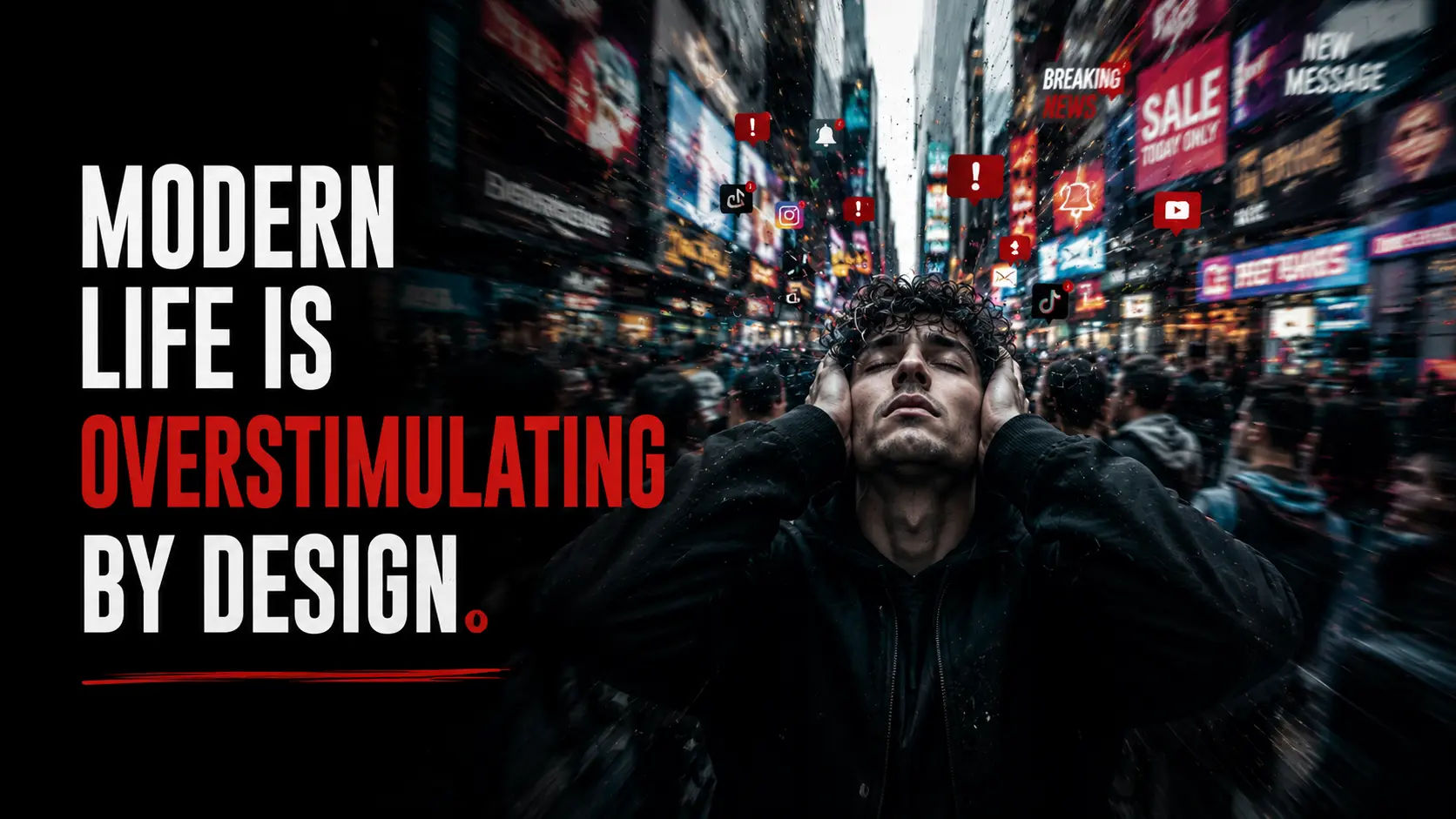
Modern life rarely gives the mind a chance to rest.
From the moment most people wake up, they are surrounded by:
- notifications
- advertisements
- short videos
- breaking news
- endless opinions
- background noise
- constant updates
The stimulation never really stops.
And increasingly, it is not accidental.
Modern systems are designed to compete for attention.
The Economy Of Attention
Many of the world’s largest platforms make money by keeping people engaged for as long as possible.
The longer attention stays locked onto a screen, the more valuable it becomes.
This creates an environment where:
- silence loses value
- slowness feels uncomfortable
- boredom disappears
- stimulation becomes constant
Everything competes to become more immediate, more emotional, and more addictive.
Not because it improves life.
Because it increases engagement.
The Mind Never Fully Disconnects
There was a time when people naturally experienced mental separation from information.
Work ended. Stores closed. Conversations paused. Silence existed.
Today, information follows people everywhere.
A person can wake up and instantly consume:
- global news
- social comparison
- work messages
- entertainment
- political outrage
- AI-generated content
all before fully waking up.
The nervous system rarely gets a true break from input.
Overstimulation Feels Normal Now
One of the strangest parts of modern life is how quickly people adapt to overload.
Many people now consider it normal to:
- watch videos while eating
- scroll while walking
- switch apps every few seconds
- multitask constantly
- sleep beside notifications
Stillness begins to feel unusual.
Attention becomes fragmented by default.
And eventually, people stop noticing how mentally exhausted they actually are.
Convenience Often Increases Noise
Technology solves many problems.
But it also removes friction.
Everything becomes immediate:
- entertainment
- communication
- shopping
- stimulation
- validation
The problem is not convenience itself.
The problem is that human attention has limits.
The brain was never designed to process an endless stream of stimulation without pause.
Algorithms Learn Human Weaknesses
Modern algorithms are becoming increasingly sophisticated at predicting behavior.
They learn:
- what captures attention
- what triggers emotion
- what keeps people scrolling
- what increases engagement
This creates systems that continuously optimize themselves around human impulses.
The result is an environment where distraction becomes personalized.
Mental Exhaustion Without Physical Effort
Many people feel tired even when they have not done physically demanding work.
Part of that exhaustion comes from cognitive overload.
The brain is constantly:
- processing information
- filtering notifications
- switching attention
- comparing
- reacting
- consuming
Mental energy gets depleted quietly.
Not through one major event.
But through endless small interruptions.
Clarity Requires Space
Clear thinking rarely happens in environments filled with constant stimulation.
It usually requires:
- silence
- uninterrupted attention
- reflection
- slower thinking
- mental space
Things modern systems rarely encourage.
That may be why clarity feels increasingly rare.
Not because people are incapable of deep thought.
But because overstimulation leaves very little room for it.
Final Thought
Modern life rewards speed, reaction, and constant engagement.
But human beings still need:
- rest
- silence
- reflection
- stillness
Without those things, attention becomes fragmented.
And fragmented attention eventually fragments the mind itself.