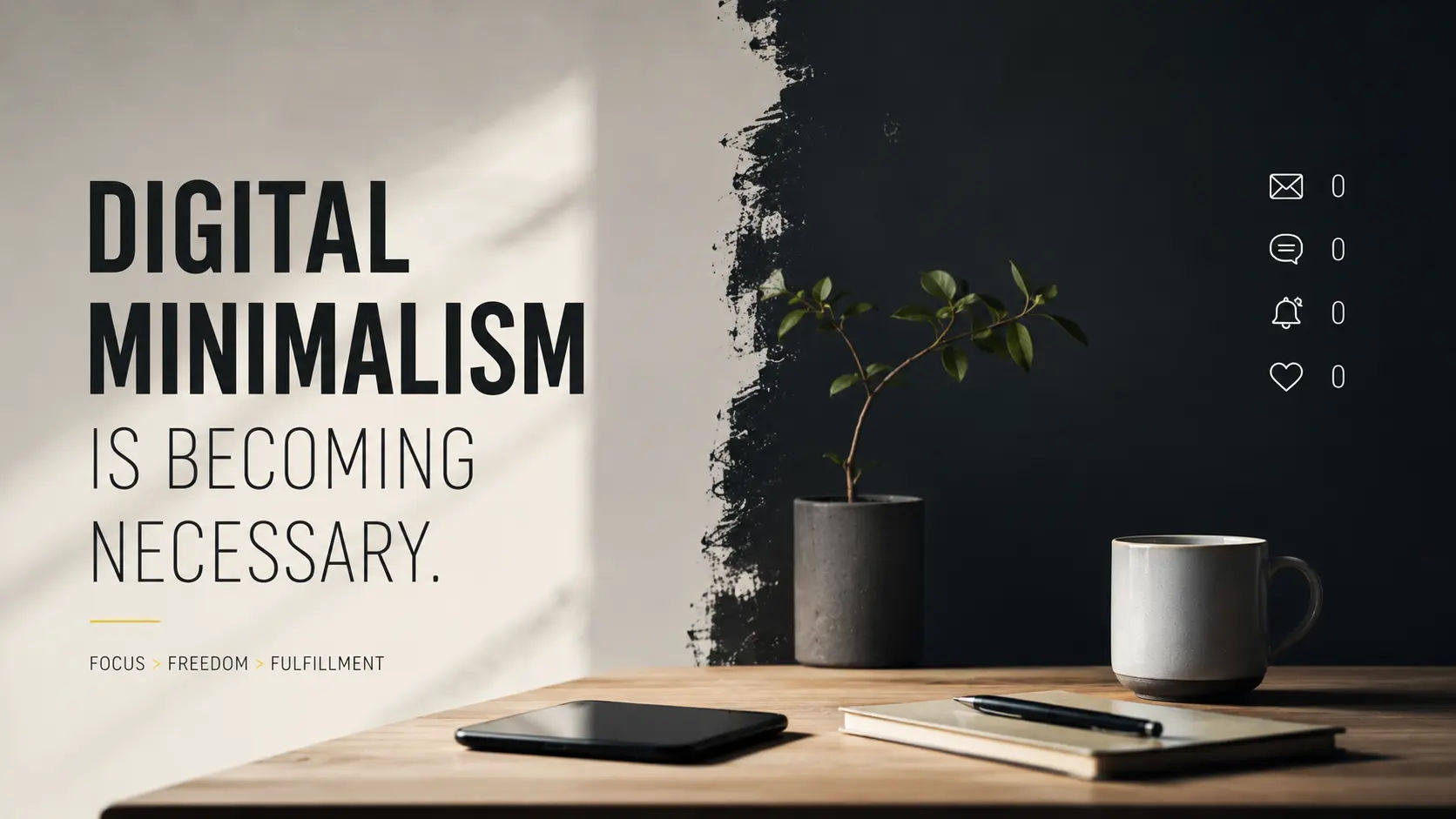
Modern technology made life more connected, efficient, and convenient.
But it also made attention constantly accessible.
Most people now live surrounded by:
- notifications
- endless content
- algorithmic feeds
- constant updates
- digital noise
- uninterrupted stimulation
At first, it feels normal.
Over time, it becomes exhausting.
That is why digital minimalism is increasingly becoming less of a lifestyle preference and more of a psychological necessity.
More Technology Did Not Create More Clarity
Technology solved many practical problems.
But mentally, modern life often feels more fragmented than ever.
People consume enormous amounts of:
- information
- entertainment
- opinions
- news
- short-form content
yet many still feel:
- mentally scattered
- emotionally overwhelmed
- unable to focus deeply
The problem is not simply technology itself.
It is the volume and intensity of constant digital input.
Attention Became Overcrowded
The modern internet constantly competes for attention.
Every platform wants:
- engagement
- retention
- visibility
- screen time
As a result, people rarely experience uninterrupted mental space.
Even brief moments of silence quickly become filled with:
- scrolling
- checking notifications
- consuming content
- reacting to updates
The mind remains continuously occupied.
Convenience Quietly Became Dependency
Many digital tools are genuinely useful.
But convenience can slowly turn into dependence when people lose the ability to exist comfortably without constant stimulation.
A person may instinctively reach for a phone during:
- boredom
- silence
- uncertainty
- discomfort
- loneliness
Not because the action is necessary.
Because the habit became automatic.
More Consumption Does Not Always Improve Life
Modern culture often encourages the idea that more information is always beneficial.
But endless consumption can reduce clarity instead of improving it.
The brain was never designed to process:
- infinite content
- constant comparison
- nonstop stimulation
- uninterrupted novelty
Without boundaries, attention becomes fragmented.
And fragmented attention eventually affects emotional well-being.
Digital Minimalism Creates Space
Digital minimalism is not about rejecting technology entirely.
It is about becoming more intentional with attention.
The goal is not complete disconnection.
The goal is reducing unnecessary noise.
That can mean:
- fewer notifications
- less mindless scrolling
- intentional technology use
- periods of silence
- fewer digital distractions
Not to become more productive alone.
But to think more clearly.
The Ability To Disconnect Is Becoming Valuable
As digital environments become increasingly optimized for engagement, the ability to step away becomes more important.
People who can:
- protect attention
- tolerate silence
- focus intentionally
- disconnect periodically
may preserve something modern systems constantly compete for:
mental clarity.
AI May Intensify The Need For Minimalism
Artificial intelligence will likely make digital environments even more personalized and engaging.
Content will become:
- faster
- more adaptive
- more emotionally targeted
- more difficult to disengage from
This makes intentional attention management increasingly necessary.
Without boundaries, people may gradually lose control over how their attention gets directed.
Simplicity Creates Mental Breathing Room
Many people assume they need:
- more apps
- more systems
- more information
- more optimization
But often what the mind actually needs is less.
Less noise. Less interruption. Less stimulation.
Simplicity creates space for:
- reflection
- deeper focus
- emotional recovery
- clearer thinking
Things modern digital environments rarely encourage naturally.
Final Thought
Technology is becoming more powerful every year.
That is unlikely to change.
But human attention still has limits.
Digital minimalism is not about escaping modern life.
It is about protecting enough mental space to remain conscious inside it.