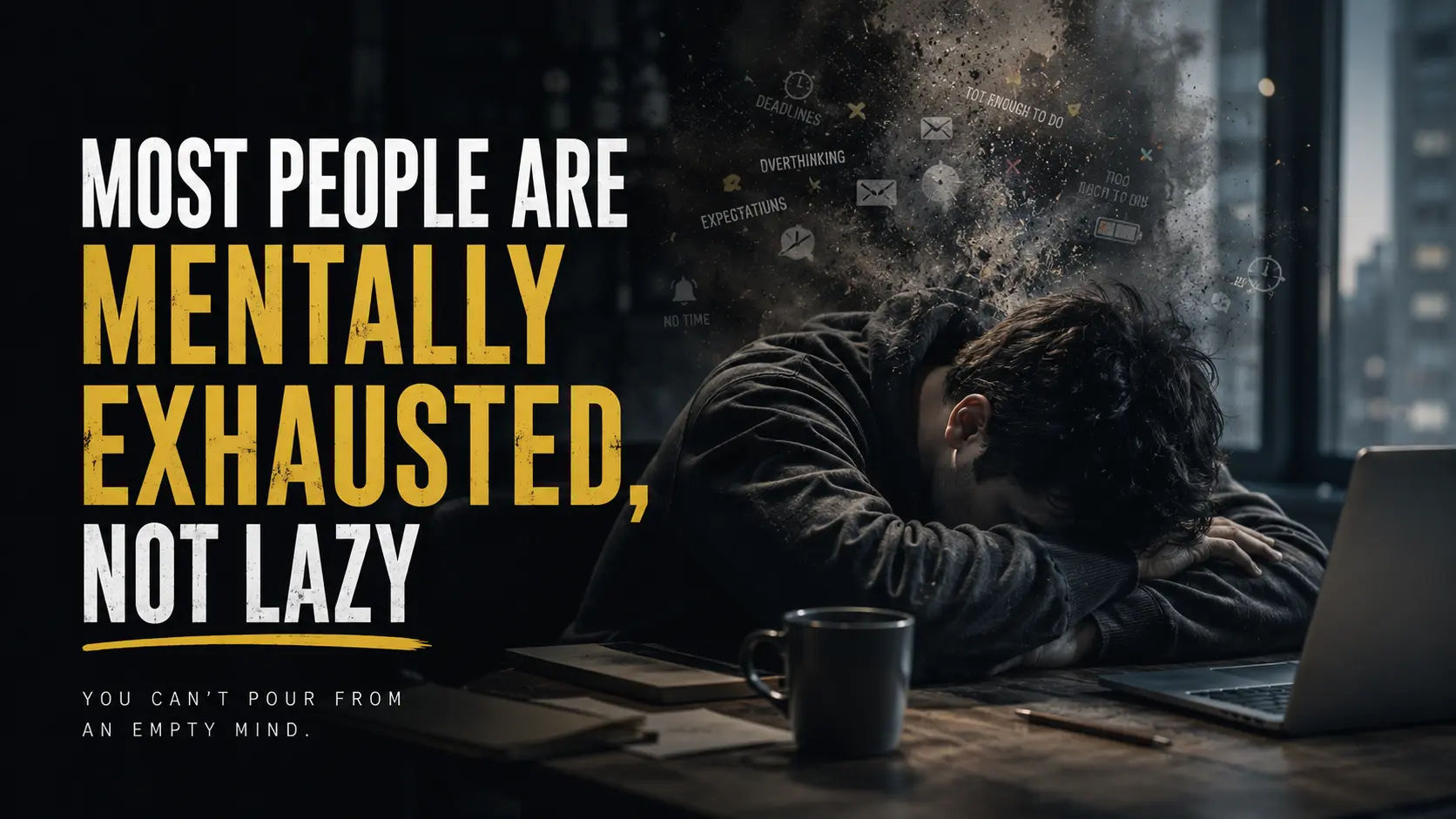
A large number of people today feel constantly tired.
Not physically tired.
Mentally tired.
Even after resting, many still feel:
- unfocused
- emotionally drained
- overwhelmed
- unable to think clearly
The common explanation is often laziness.
But that explanation misses how mentally demanding modern life has become.
The Brain Rarely Gets To Rest
Modern life keeps attention continuously active.
From the moment many people wake up, the brain begins processing:
- notifications
- messages
- emails
- news
- social media
- advertisements
- endless information
Even moments that once allowed mental recovery are now filled with stimulation.
The nervous system rarely experiences true stillness.
Mental Energy Is Finite
Human attention has limits.
Every decision, interruption, notification, and emotional reaction consumes cognitive energy.
Modern environments constantly demand:
- rapid attention switching
- emotional processing
- multitasking
- information filtering
- social comparison
- instant responses
Over time, this creates continuous low-level mental fatigue.
Not because people are weak.
Because the brain is overloaded.
Constant Attention Switching Is Draining
One of the most exhausting parts of modern life is fragmented attention.
People rarely focus on one thing for long periods anymore.
Instead, attention constantly jumps between:
- apps
- conversations
- videos
- tasks
- alerts
- tabs
- feeds
The brain repeatedly resets itself every time attention shifts.
That process quietly drains mental energy throughout the day.
Overstimulation Creates Emotional Fatigue
Modern life is not only informationally overwhelming.
It is emotionally overwhelming too.
Within minutes, a person may encounter:
- outrage
- fear
- comparison
- tragedy
- entertainment
- anxiety-inducing headlines
- unrealistic lifestyles
The nervous system processes far more emotional input than it was designed to handle continuously.
Eventually, people begin feeling emotionally numb or mentally depleted without fully understanding why.
Productivity Culture Misunderstands The Problem
Modern productivity culture often assumes people simply need:
- more discipline
- more motivation
- better habits
- stricter routines
But exhausted minds struggle to function clearly.
Sometimes the issue is not lack of ambition.
It is cognitive overload.
A distracted, overstimulated brain cannot maintain deep focus indefinitely.
Rest No Longer Feels Restful
Many people technically rest without mentally disconnecting.
A person may stop working while still:
- scrolling endlessly
- consuming content
- checking notifications
- reacting to information
The body pauses.
The mind continues processing.
Real rest usually requires reduced stimulation, not just physical inactivity.
The Brain Adapts To Chaos
Human attention adapts to repeated environments.
When life becomes filled with:
- interruptions
- urgency
- constant updates
- endless stimulation
the nervous system gradually normalizes that chaos.
Stillness can even begin feeling uncomfortable because the brain becomes conditioned to constant input.
Clarity Requires Recovery
Clear thinking depends heavily on mental recovery.
The brain needs:
- silence
- slower pacing
- uninterrupted focus
- emotional space
- reduced stimulation
Without those things, people often remain in a constant state of low-level exhaustion.
Not visibly collapsing.
Just mentally overloaded.
Final Thought
Many people are not failing because they lack discipline.
They are trying to function clearly inside environments designed around constant stimulation and interruption.
The modern world demands enormous amounts of attention.
Eventually, the mind pays the price for it.
And sometimes what looks like laziness is actually exhaustion that never had time to recover.