The Death Of Deep Thinking
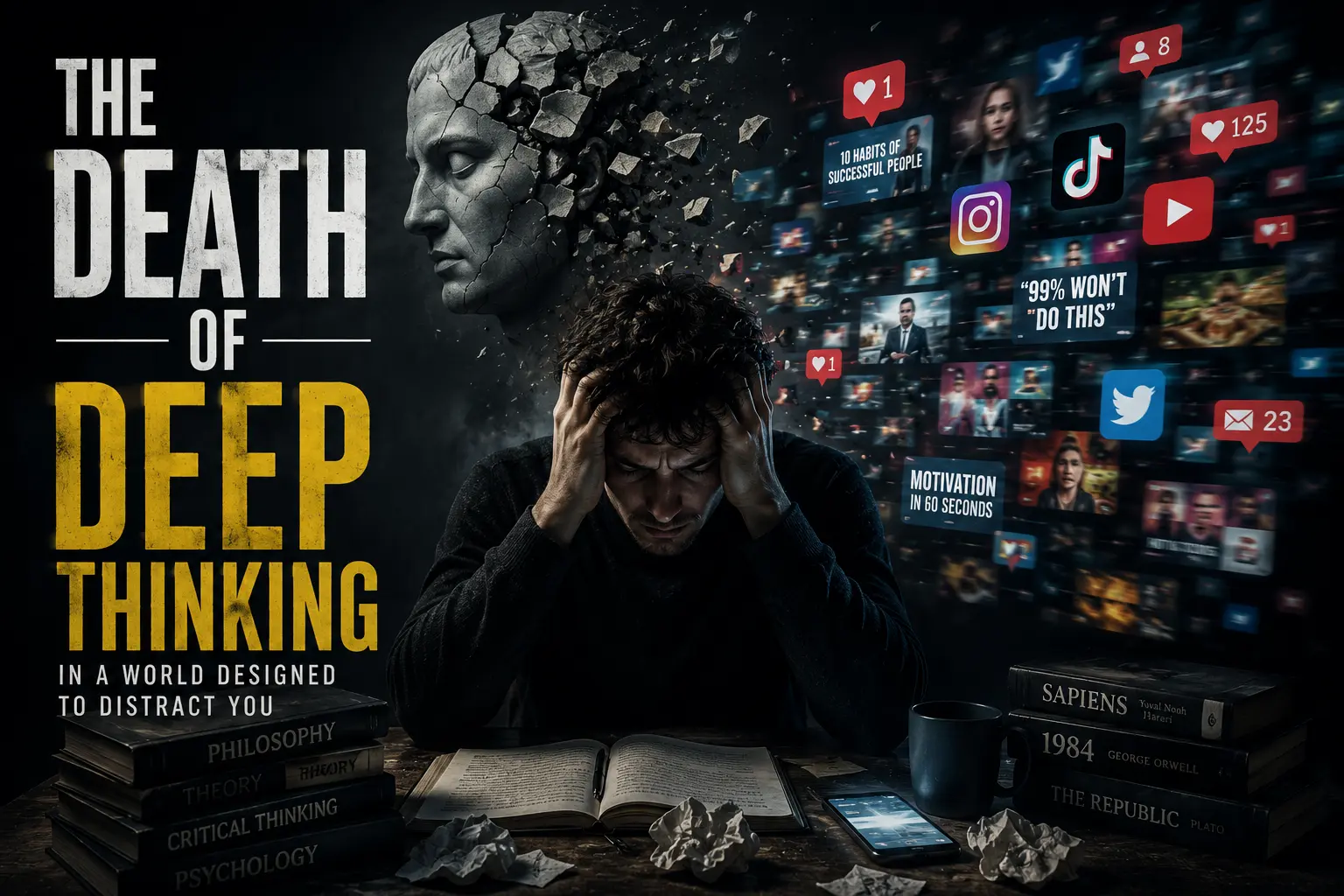
Modern life rewards speed, reaction, and constant stimulation. Deep thinking still exists, but the environments that support it are becoming increasingly rare.
The Death Of Deep Thinking
Deep thinking is becoming increasingly rare.
Not because people are less intelligent.
Not because knowledge has disappeared.
But because modern life rarely creates the conditions that deep thinking requires.
The ability to sit with a complex idea, explore it patiently, and follow it to its conclusion is slowly being replaced by something else:
constant consumption.
Information Became Endless
For most of history, information was relatively scarce.
People had limited access to: - books - news - expert opinions - educational resources
Today the problem is the opposite.
Information is infinite.
At any moment, people can access: - articles - podcasts - videos - social media - AI-generated content - endless commentary
The challenge is no longer finding information.
The challenge is thinking deeply enough about it to understand it.
Consumption Replaced Reflection
Modern technology made consuming information effortless.
Learning, however, still requires effort.
Many people spend hours every day consuming content about: - psychology - productivity - philosophy - technology - self-improvement
Yet surprisingly little time is spent reflecting on any of it.
The result is a strange illusion:
feeling informed without becoming wiser.
The Internet Rewards Speed
Deep thinking is slow.
The internet is fast.
Most online platforms reward: - immediacy - reaction - novelty - engagement
Not patience.
A thoughtful conclusion often requires: - uncertainty - questioning assumptions - changing perspectives - sitting with complexity
These processes do not fit neatly into the rhythm of modern digital environments.
Constant Stimulation Interrupts Thought
Deep thinking requires uninterrupted attention.
But attention today is constantly fragmented by: - notifications - messages - social feeds - recommendations - breaking news
Every interruption resets part of the thinking process.
The mind rarely remains focused on a single idea long enough to explore it fully.
As a result, thoughts become shallower and more fragmented.
Complexity Feels Uncomfortable
Many important questions do not have simple answers.
Questions about: - meaning - identity - society - technology - human behavior
often involve ambiguity.
Deep thinking requires tolerating uncertainty.
Modern culture increasingly prefers certainty.
Quick answers feel more satisfying than complex ones.
Even when they are less accurate.
Thinking Became Public
Much of modern thinking now happens in public spaces.
People are encouraged to: - share opinions immediately - react publicly - take positions quickly
But genuine thinking often begins privately.
It involves: - doubt - confusion - experimentation - changing one's mind
The pressure to appear certain can discourage deeper intellectual exploration.
Attention Is The Foundation Of Thought
Every meaningful idea begins with attention.
Without sustained attention: - understanding weakens - reflection decreases - insight becomes rare
Deep thinking is not simply a matter of intelligence.
It is largely a matter of focus.
And focus has become increasingly difficult to protect.
AI May Make The Problem Worse
Artificial intelligence makes information easier to generate than ever before.
Answers can now appear instantly.
But access to answers is not the same as understanding.
There is a risk that people become increasingly dependent on external systems for thinking while spending less time developing their own reasoning abilities.
Knowledge may become more accessible.
Reflection may become less common.
Deep Thinking Still Matters
Many of humanity's most important discoveries emerged from people spending long periods of time thinking deeply.
Not scrolling. Not reacting. Not multitasking.
Thinking.
The ability to: - question assumptions - explore ideas - tolerate uncertainty - think independently
remains one of the most valuable human abilities.
Even if modern systems rarely encourage it.
Final Thought
The greatest threat to deep thinking is not a lack of intelligence.
It is a lack of space.
Deep thought requires silence, attention, patience, and time.
Modern life provides endless information but very little room to process it.
And in a world overflowing with content, the ability to think deeply may become one of the rarest skills of all.

Newsletter
Stay in the loop
Get new posts delivered straight to your inbox. No spam, unsubscribe anytime.
Related Posts
AI Will Change Human Identity More Than Jobs
Artificial intelligence will affect far more than employment. It may fundamentally change how people define value, creativity, intelligence, and identity itself.
Consumerism Became Identity
Modern consumer culture no longer sells products alone. It increasingly sells identity, belonging, status, and a sense of self.
Digital Minimalism Is Becoming Necessary
Modern technology surrounds people with constant stimulation, information, and distraction. Digital minimalism is becoming less of a lifestyle trend and more of a psychological necessity.