Consumerism Became Identity
Modern consumer culture no longer sells products alone. It increasingly sells identity, belonging, status, and a sense of self.
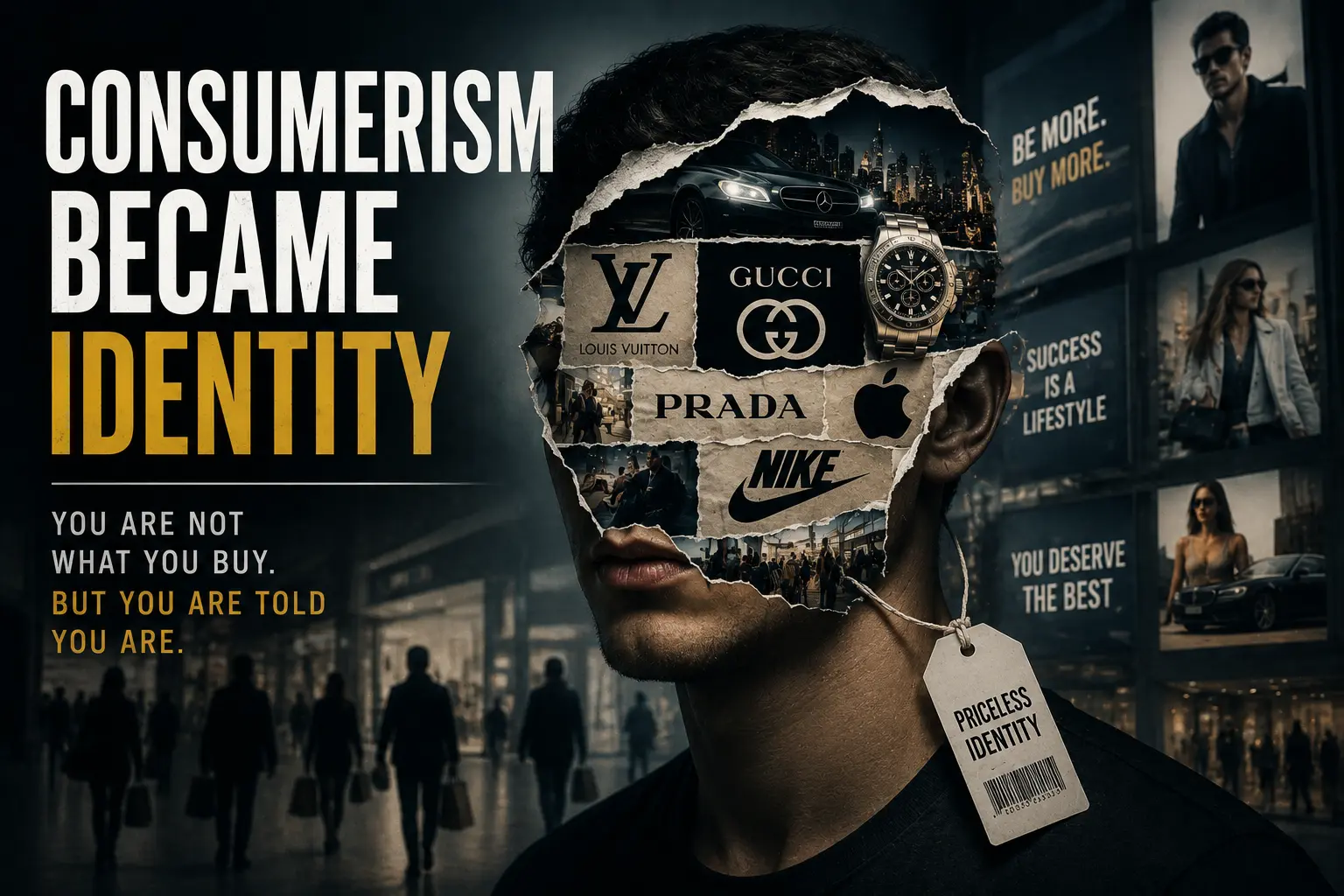
Consumerism Became Identity
People no longer buy products simply because they need them.
Increasingly, people buy products because of what those products say about who they are.
A phone is not just a phone.
A car is not just transportation.
A brand is not just a company.
Many purchases now communicate: - status - values - personality - lifestyle - belonging
Consumerism evolved beyond consumption.
It became identity.
Products Became Symbols
In the past, products primarily solved practical problems.
A jacket kept people warm. A watch told time. A vehicle provided transportation.
Today many products serve an additional purpose.
They communicate information about the person using them.
People often purchase things that signal:
- success - creativity - intelligence - taste - social status - personal values
The object becomes a symbol.
Sometimes the symbol becomes more important than the function.
Modern Marketing Sells Identity
Most advertising no longer focuses exclusively on products.
It focuses on stories.
Companies rarely sell: - shoes - phones - clothing - vehicles
Instead, they sell ideas.
Ideas about: - who you could become - how others might perceive you - what group you belong to
The message is often subtle:
buy this, and it becomes part of who you are.
The Search For Identity Never Disappeared
Human beings naturally seek identity.
People want answers to questions such as:
- Who am I? - Where do I belong? - What makes me different? - What gives my life meaning?
Traditionally these questions were often answered through: - family - community - religion - culture - shared experiences
Many of those structures weakened in modern society.
Consumer culture filled part of the gap.
Consumption Became Self-Expression
Today people often express themselves through what they consume.
Music. Fashion. Technology. Entertainment. Lifestyle brands.
Consumption becomes a way of communicating identity.
There is nothing inherently wrong with self-expression.
The challenge appears when identity becomes heavily dependent on external purchases.
Because purchased identity often requires constant maintenance.
The Cycle Never Ends
Consumerism thrives on dissatisfaction.
If people felt permanently fulfilled, they would stop buying.
As a result, modern culture continuously promotes the idea that something better is always available.
A newer version. A better upgrade. A higher status symbol. A more desirable lifestyle.
The finish line keeps moving.
People continue chasing improvements without ever feeling fully complete.
Social Media Accelerated The Process
Social media transformed consumption into public performance.
People now display: - purchases - experiences - lifestyles - possessions
to large audiences.
The line between living and presenting life became increasingly blurred.
Consumption became visible.
And visible consumption became social currency.
Identity Through Consumption Is Fragile
One challenge with consumer-based identity is that it depends heavily on external factors.
Products change. Trends change. Brands change.
When identity becomes tied to those things, it can become unstable.
A person may spend years building an image without fully understanding who they are beyond it.
The result is often a persistent feeling that something is missing.
Meaning Cannot Be Purchased
Consumer culture is remarkably effective at selling solutions.
But some human needs cannot be satisfied through consumption.
Things like: - purpose - connection - belonging - self-understanding - meaning
develop differently.
They are built through experience, reflection, relationships, and participation in life.
Not through transactions.
Reclaiming Identity
The solution is not rejecting every product or abandoning modern life.
The goal is awareness.
To recognize the difference between:
- expressing identity - purchasing identity
One comes from within.
The other depends on external validation.
The distinction matters.
Final Thought
Consumerism no longer sells products alone.
It increasingly sells stories about who people are and who they could become.
The danger is not buying things.
The danger is forgetting that identity cannot ultimately be purchased.
Because no matter how much someone owns, the question remains:
Who are you when the labels, brands, and possessions are removed?
The answer to that question cannot be found in a shopping cart.

Newsletter
Stay in the loop
Get new posts delivered straight to your inbox. No spam, unsubscribe anytime.
Related Posts
AI Will Change Human Identity More Than Jobs
Artificial intelligence will affect far more than employment. It may fundamentally change how people define value, creativity, intelligence, and identity itself.
Digital Minimalism Is Becoming Necessary
Modern technology surrounds people with constant stimulation, information, and distraction. Digital minimalism is becoming less of a lifestyle trend and more of a psychological necessity.
Modern Life Is Overstimulating By Design
Modern systems are built to maximize stimulation, engagement, and consumption. The result is a constant state of mental overload.