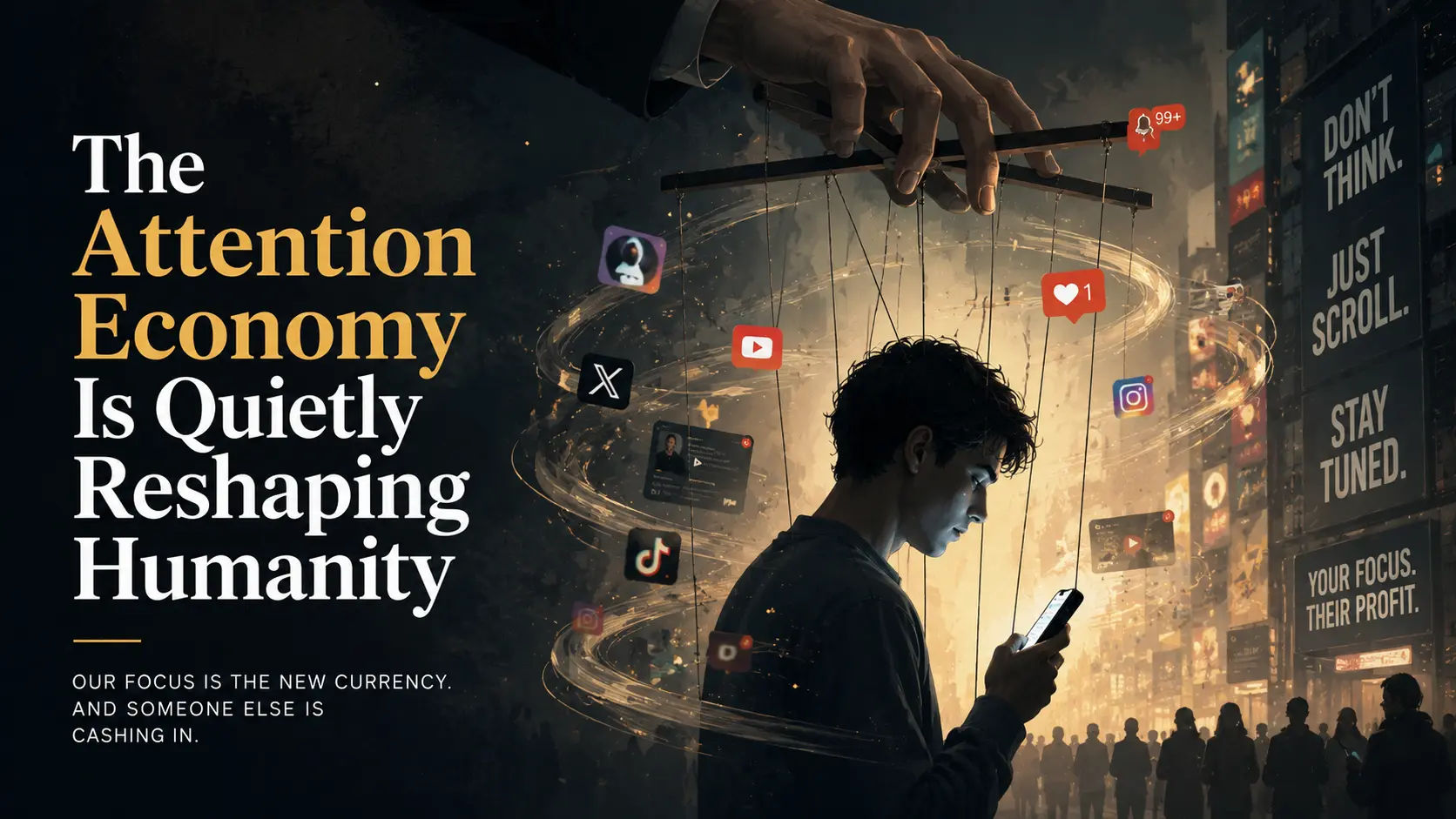
Human attention has become one of the most valuable resources in the modern world.
Not oil. Not data. Not even technology itself.
Attention.
Every platform, application, algorithm, and media system now competes to capture as much of it as possible.
And slowly, that competition is changing the way people think, behave, and experience reality.
Attention Became A Business Model
Many modern platforms are built around one core objective:
keep people engaged for as long as possible.
The longer users stay connected to a platform:
- the more advertisements they see
- the more data gets collected
- the more profitable they become
This creates systems designed to maximize:
- stimulation
- emotional reaction
- scrolling
- consumption
- habit formation
Human attention is no longer simply observed.
It is actively engineered.
The Most Valuable Companies Compete For Human Focus
Some of the largest companies in the world are no longer selling products directly.
They are selling attention.
Every notification. Every autoplay recommendation. Every infinite feed. Every personalized algorithm.
All of it exists to reduce the chances of disengagement.
The goal is not necessarily clarity or well-being.
The goal is continued attention.
Human Psychology Became Predictable Data
Modern algorithms learn human behavior at enormous scale.
They study:
- what keeps people watching
- what triggers emotion
- what increases outrage
- what creates dependency
- what prevents users from leaving
Over time, platforms become increasingly effective at predicting attention patterns.
This creates an environment where digital systems understand human impulses with growing precision.
Sometimes better than people understand themselves.
Constant Engagement Changes The Mind
The brain adapts to the environments it repeatedly experiences.
When people spend years in environments optimized for:
- rapid stimulation
- constant novelty
- emotional intensity
- endless scrolling
attention itself changes.
Stillness becomes difficult. Silence feels uncomfortable. Deep focus requires effort.
The mind gradually adapts to fragmentation.
Not because people lack intelligence.
Because the environment rewards distraction.
The Economy Rewards Reaction
The attention economy does not reward calm reflection very well.
It rewards:
- speed
- outrage
- controversy
- novelty
- emotional intensity
Content spreads faster when it generates strong immediate reactions.
As a result, modern communication increasingly becomes:
- reactive instead of reflective
- emotional instead of thoughtful
- fast instead of deep
This affects not just platforms.
It affects culture itself.
AI Will Intensify The Competition
Artificial intelligence will likely accelerate the attention economy dramatically.
Content is becoming:
- more personalized
- more adaptive
- more emotionally optimized
- easier to generate at scale
Algorithms will increasingly learn:
- individual preferences
- emotional triggers
- behavioral patterns
- psychological weaknesses
The battle for human attention may become far more sophisticated than it already is.
Attention Shapes Reality
What people consistently pay attention to eventually shapes:
- perception
- emotion
- priorities
- identity
- worldview
This makes attention more than a productivity issue.
It becomes a human issue.
Because whatever repeatedly captures attention eventually influences the structure of thought itself.
Clarity Becomes A Form Of Resistance
In an environment built to constantly interrupt attention, clarity becomes increasingly valuable.
Not because clarity is complicated.
But because uninterrupted thinking is becoming rare.
The ability to:
- focus intentionally
- think slowly
- reflect deeply
- disconnect temporarily
- sit with silence
is becoming less common in modern life.
That may also be why it matters more than ever.
Final Thought
The attention economy is not only competing for time.
It is competing for perception.
And over time, the systems that shape attention quietly begin shaping humanity itself.