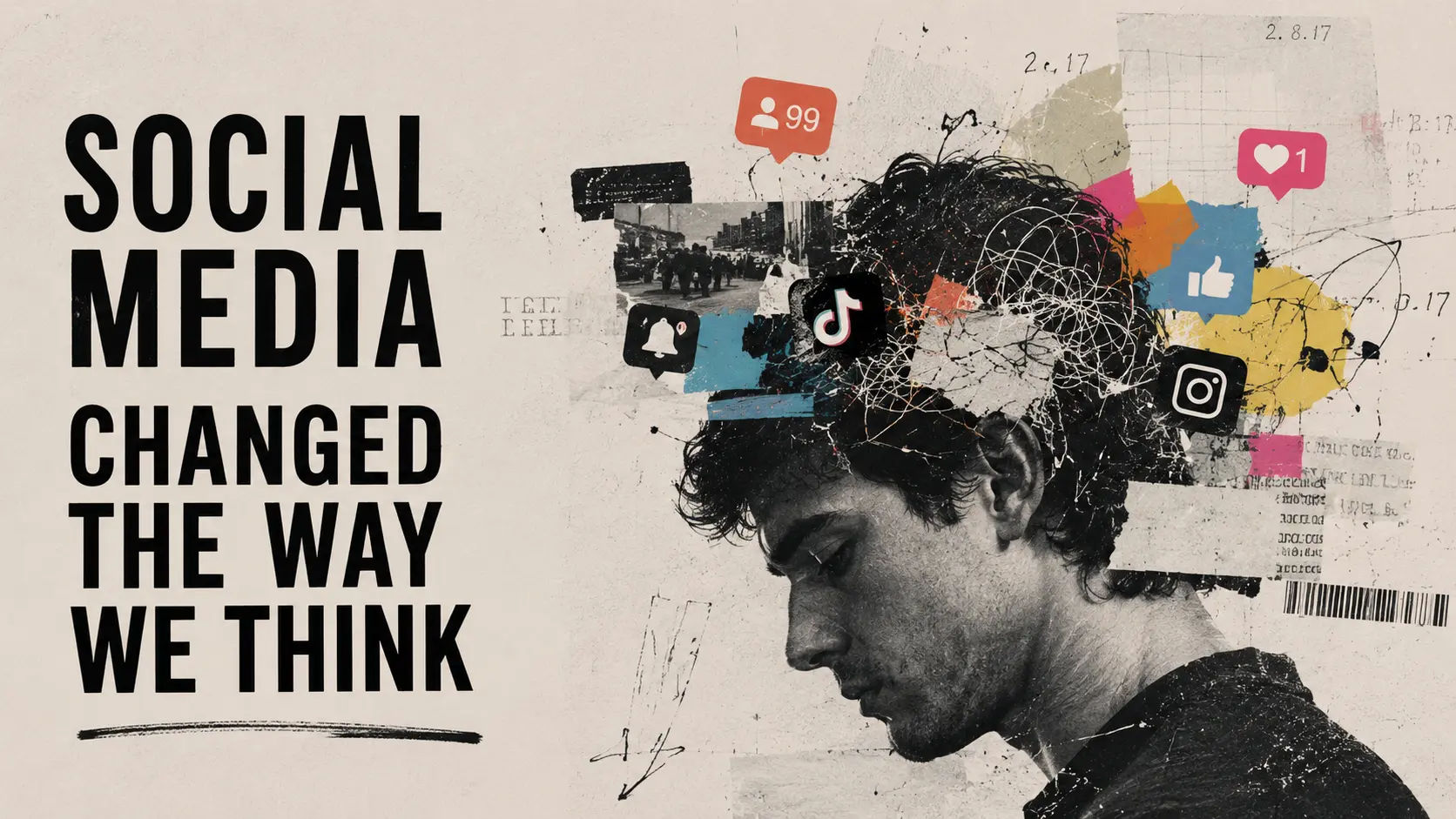
Social media did not simply change communication.
It changed perception.
For most of human history, people experienced life directly:
- conversations happened physically
- opinions spread slowly
- identity developed privately
- attention remained relatively local
Now much of modern life is filtered through platforms designed around visibility, engagement, and reaction.
The result is not just technological change.
It is psychological change.
Attention Became Fragmented
Social media trains people to consume information in rapid, disconnected fragments.
A person can scroll through:
- world news
- political outrage
- comedy clips
- personal achievements
- tragedy
- advertisements
- motivational advice
all within a few seconds.
The mind constantly switches emotional and cognitive states without pause.
Over time, this affects attention itself.
Thinking becomes faster, shorter, and more reactive.
Deep reflection becomes harder to maintain.
The Brain Adapts To Speed
Human attention adapts to whatever environment it experiences repeatedly.
Short-form content encourages:
- instant stimulation
- quick emotional reactions
- rapid novelty
- constant scrolling
The brain begins expecting continuous input.
Silence feels slower. Books feel harder. Long conversations require more effort.
Not because people became less intelligent.
Because the environment changed the rhythm of attention.
Identity Became Public
Social media also changed how people build identity.
For much of history, identity developed through:
- family
- local communities
- private experiences
- real-world interaction
Now identity is increasingly shaped through public presentation.
People learn to think about themselves through:
- likes
- views
- engagement
- followers
- comparison
- online perception
The self becomes partially externalized.
Instead of asking:
“Who am I really?”
many people unconsciously begin asking:
“How am I being perceived?”
That changes behavior more than most people realize.
Comparison Became Constant
Humans naturally compare themselves to others.
Social media amplified that instinct to a global scale.
At any moment, people can compare themselves against:
- influencers
- celebrities
- entrepreneurs
- creators
- strangers
- idealized lifestyles
Most of those images are carefully curated.
But emotionally, the brain often reacts as if they represent reality.
The result is a continuous sense of:
- inadequacy
- pressure
- insecurity
- urgency
even when life itself may be relatively stable.
Emotion Became Algorithmic
Platforms reward emotional intensity because strong emotion increases engagement.
Outrage spreads quickly. Fear spreads quickly. Conflict spreads quickly.
Calm reflection rarely goes viral.
This gradually shapes collective behavior.
People become more reactive. More impulsive. More emotionally overstimulated.
The internet starts rewarding performance over understanding.
Opinion Replaced Reflection
Social media encourages immediate responses.
People are expected to:
- react instantly
- comment quickly
- take positions immediately
There is little space for uncertainty, nuance, or slow thinking.
But meaningful understanding often requires:
- patience
- ambiguity
- reflection
- time
Modern platforms rarely optimize for those things.
The Fear Of Missing Out
One of social media’s most powerful psychological effects is the feeling that something important is always happening elsewhere.
There is always:
- another trend
- another conversation
- another update
- another opportunity
- another controversy
The mind stays partially attached to the possibility of missing something.
This creates low-level psychological tension that many people experience daily without fully noticing.
Human Attention Is Still Human
Technology evolved rapidly.
Human psychology did not.
People still need:
- rest
- silence
- real connection
- uninterrupted attention
- emotional stability
But modern digital environments often move in the opposite direction.
The result is a world where people are more connected than ever, yet often feel:
- mentally scattered
- emotionally overwhelmed
- psychologically exhausted
Final Thought
Social media changed more than communication.
It changed:
- attention
- identity
- emotion
- perception
- behavior
The effects are subtle because they happen gradually.
But over time, the environment people spend their attention in eventually shapes the way they think.
And increasingly, modern attention is being shaped by algorithms.