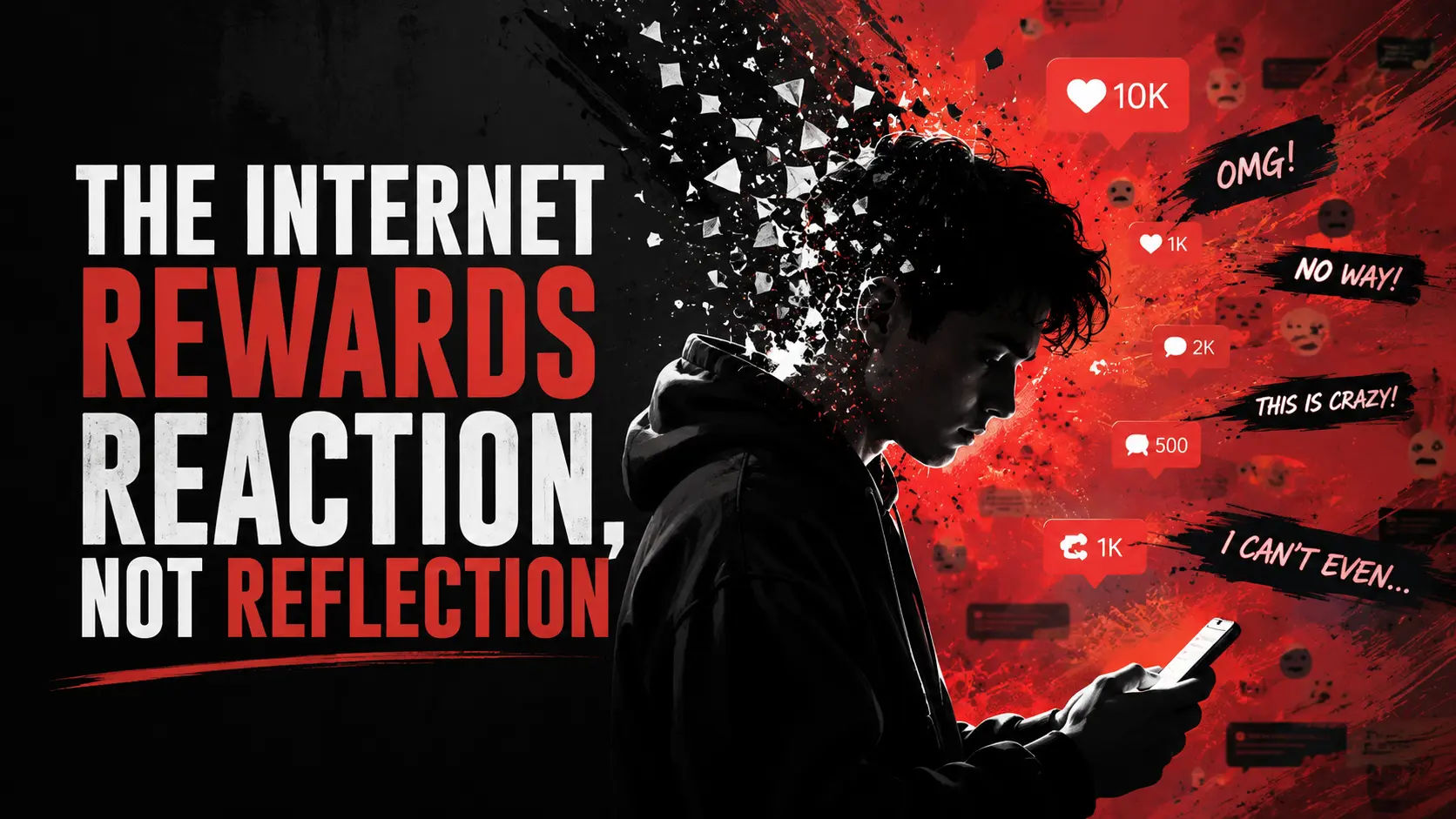
The modern internet moves extremely fast.
Information appears instantly. Opinions spread immediately. Conversations shift constantly.
The pressure to react never really stops.
People are expected to:
- respond quickly
- form opinions immediately
- comment instantly
- keep up continuously
In that environment, reflection becomes difficult.
Not because people no longer value thoughtfulness.
But because digital systems increasingly reward speed over depth.
Reaction Spreads Faster Than Reflection
Fast emotional responses perform well online.
Outrage spreads quickly. Fear spreads quickly. Conflict spreads quickly.
Strong reactions generate:
- clicks
- engagement
- shares
- visibility
Reflection moves differently.
It requires:
- time
- uncertainty
- patience
- emotional restraint
Things modern platforms rarely optimize for.
Algorithms Reward Emotional Intensity
Most social platforms are designed around engagement.
The content that keeps people emotionally activated tends to spread further.
As a result, the internet naturally amplifies:
- controversy
- urgency
- outrage
- certainty
- conflict
Calm nuance struggles to compete with emotionally charged reactions.
This gradually shapes collective behavior.
People begin adapting to the rhythm of the environment itself.
Immediate Opinions Became Normal
The internet created a culture where people are expected to react instantly to almost everything.
News appears. People respond immediately. Trends emerge. Opinions form within minutes.
There is very little space for:
- uncertainty
- silence
- slower understanding
- changing perspectives
But meaningful understanding often develops slowly.
Reflection rarely happens in real time.
Attention Rarely Settles
The internet constantly redirects attention toward the next stimulus.
Before people fully process one event, another arrives.
The cycle repeats endlessly:
- headlines
- outrage
- trends
- viral moments
- new controversies
The result is fragmented thinking.
Attention jumps continuously between emotionally stimulating information without enough space for deeper processing.
Reflection Requires Distance
Clear thinking often requires temporary separation from noise.
People usually understand situations more clearly after:
- slowing down
- sitting with uncertainty
- observing patterns
- reflecting over time
The internet rarely encourages that process.
Instead, it encourages constant participation.
Silence can even appear suspicious online because the culture increasingly expects immediate visibility and reaction.
Performance Replaces Understanding
Online environments often reward appearing informed more than becoming informed.
People feel pressure to:
- say something quickly
- demonstrate awareness
- publicly react
- maintain visibility
This creates a subtle shift where communication becomes partially performative.
The goal quietly changes from:
understanding reality
to:
responding visibly to reality.
Constant Reaction Creates Mental Exhaustion
Living in a state of continuous reaction is psychologically draining.
The nervous system constantly processes:
- emotional intensity
- uncertainty
- conflict
- information overload
- social pressure
Without reflection, people remain emotionally activated for long periods of time.
Over time, this contributes to:
- mental fatigue
- emotional numbness
- anxiety
- reduced attention span
Reflection Is Becoming Rare
Modern systems reward:
- speed
- visibility
- stimulation
- immediacy
Reflection rewards none of those things.
It is slower. Quieter. Less performative.
That may be why it feels increasingly uncommon online.
And also why it matters more than ever.
Final Thought
The internet gives people endless opportunities to react.
But reaction is not the same as understanding.
Reflection requires slowing down long enough to think beyond the immediate emotional moment.
In a world optimized for instant response, the ability to pause and think clearly may quietly become a form of resistance.