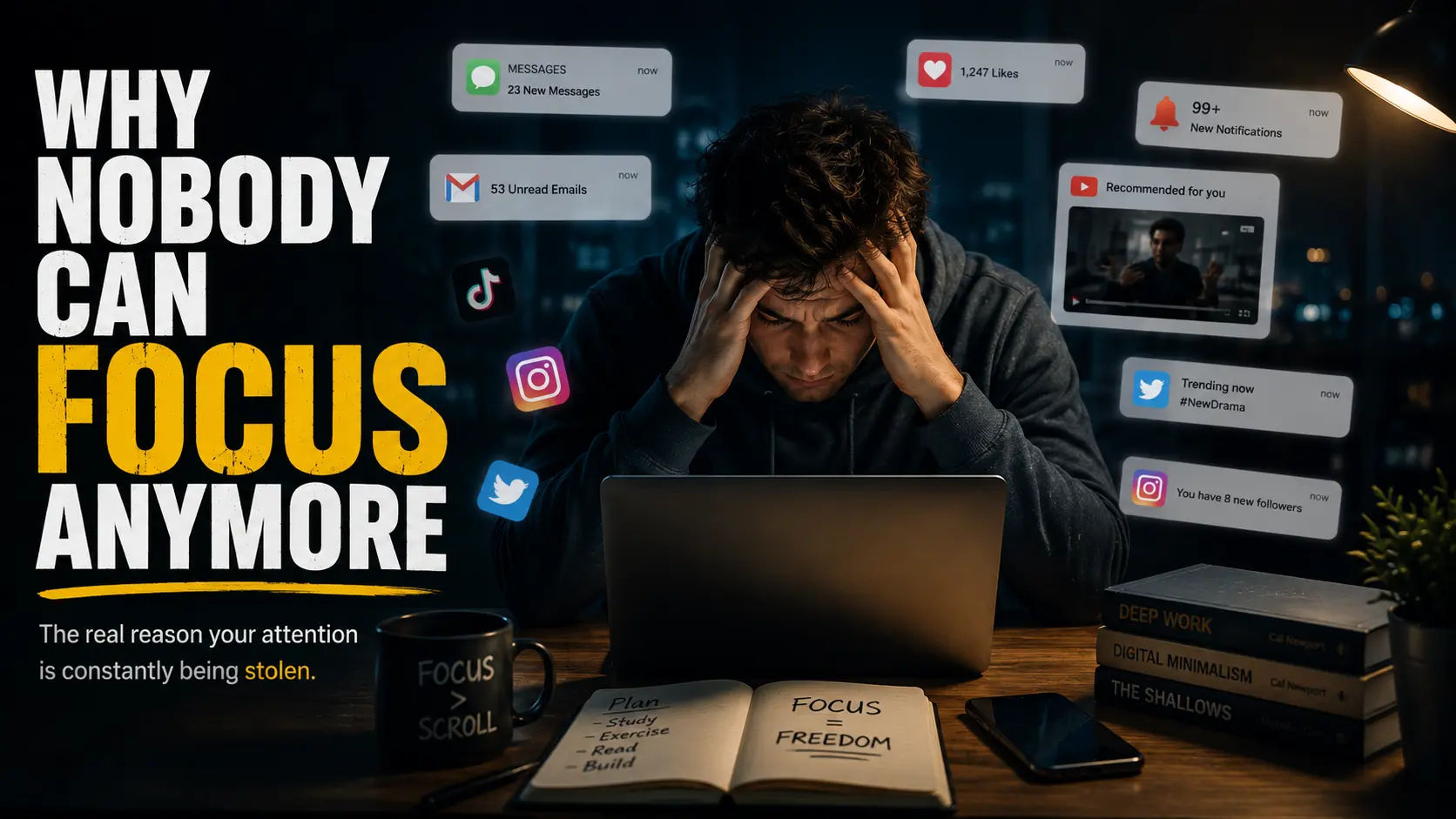
Most people are not struggling with discipline.
They are struggling with overstimulation.
Modern life surrounds us with an endless stream of information, notifications, opinions, videos, messages, recommendations, and algorithms competing for one thing:
our attention.
For the first time in history, distraction is no longer occasional.
It is constant.
Attention Became The Product
Most digital platforms are not designed to help people think clearly.
They are designed to keep people engaged for as long as possible.
Every notification, infinite scroll, autoplay recommendation, and personalized feed exists to pull attention back toward the screen.
The business model is simple:
the longer people stay engaged, the more profitable they become.
This changes the way people think, behave, and experience daily life.
Attention is no longer protected.
It is continuously interrupted.
The Brain Was Never Designed For This
Human attention evolved in environments that were relatively quiet and slow compared to modern digital life.
Now the average person switches between:
- messages
- short videos
- emails
- social feeds
- music
- advertisements
- multiple tabs
- constant notifications
all within minutes.
The brain adapts to whatever environment it repeatedly experiences.
When attention is constantly fragmented, deep focus becomes more difficult.
Not because people are lazy.
Because the environment itself trains distraction.
Constant Stimulation Creates Mental Noise
Many people no longer experience silence naturally.
Moments that used to feel empty are now immediately filled with content.
Waiting in line. Walking outside. Sitting alone. Even eating.
Everything becomes accompanied by stimulation.
Over time, the mind becomes uncomfortable with stillness because it rarely experiences it anymore.
Silence begins to feel unfamiliar.
And unfamiliar things often feel uncomfortable.
Information Without Reflection
Modern life encourages rapid consumption, not deep reflection.
People consume:
- endless opinions
- breaking news
- productivity advice
- motivational content
- AI-generated information
- short-form entertainment
but rarely stop long enough to process any of it.
The result is a strange form of mental exhaustion:
being constantly informed while feeling mentally scattered.
The problem is not lack of information.
It is lack of clarity.
Focus Requires Friction
Deep focus often feels difficult because distraction has become frictionless.
Opening a social app takes seconds.
Switching attention takes milliseconds.
The modern internet rewards reaction, speed, and stimulation.
Focus requires the opposite:
- patience
- intentionality
- boredom
- stillness
Things modern systems rarely encourage.
AI Will Intensify The Problem
Artificial intelligence will likely make the attention economy even more powerful.
Algorithms are becoming increasingly personalized, predictive, and emotionally adaptive.
Content will become:
- more targeted
- more addictive
- more optimized for engagement
The competition for human attention is only beginning.
This makes self-awareness increasingly important.
People who cannot control their attention may eventually lose the ability to control much else.
Clarity Is Becoming Rare
In a distracted world, clarity becomes valuable.
Not because clarity is mysterious.
But because modern systems constantly interrupt it.
The ability to:
- sit quietly
- think deeply
- focus intentionally
- reflect honestly
is slowly becoming uncommon.
That may also be why it matters more than ever.
Final Thought
Most people do not need more information.
They need fewer interruptions.
Attention shapes perception.
And perception quietly shapes reality.